Monday Brief No. 2, US edition
The Fed held rates. What that means for your card and savings
Figures checked Read the Canada edition
In this issue
2 min read
The Fed held its rate. Two of twelve wanted a hike
Plus!
- Marketplace enrollment for 2027 opened Nov 1.
- Gas averages $4.27 a gallon, $1.23 more than a year ago.
This week
Must-read this week
Marketplace enrollment for 2027 opened Nov 1.
On HealthCare.gov you can enroll in, renew or change a plan until Jan 15. Choose by Dec 15 for coverage that starts Jan 1.
What it means for you: Plans and prices change every year. If you buy your own health insurance, compare next year's plans before Dec 15 instead of letting yours renew as is.
Source: HealthCare.gov
Gas averages $4.27 a gallon, $1.23 more than a year ago.
The national average for regular gas fell for a second week, to $4.269 on Oct 26. Diesel kept rising, to $6.352.
What it means for you: If your budget feels tight, look at what you spend on fuel first. It has moved more than most prices this year.
Heating bills split by fuel this winter.
The EIA expects homes heated by natural gas or propane, about half of US households, to spend less this winter. Homes heated by electricity or heating oil should spend more, because those fuels cost more.
What it means for you: If you heat with electricity or oil, plan for higher bills from December. Many utilities offer budget billing that spreads the cost evenly over the year.
The numbers
This week’s rates
Inflation, September
3.7%
up from 3.4% in August
BLSPrime rate
7.00%
held with the Fed on Oct 28
Federal ReserveSavings, national average
0.38%
3-month Treasury bills: 4.16%
FDIC30-year mortgage
7.24%
6.17% a year ago
Freddie Mac
The Big Money Move
The Fed held its rate. Two of twelve wanted a hike
The Fed held its rate at 3.75% to 4.00% on Oct 28, in a 10 to 2 vote; the two wanted a quarter-point hike. Inflation was 3.7% in September (BLS). The Bank of Canada raised the same morning. Both decide next on Dec 9.
Card rates stay where they are.
Prime stays at 7.00%, and most cards charge prime plus a margin. The average card charges 22.4% a year (Federal Reserve).
What it means for you: Your card's rate doesn't change from this decision. The next one is Dec 9, and a balance you pay down before then costs less whatever happens.
Savings still trail Treasury bills.
The average savings account pays 0.38% (FDIC). Three-month Treasury bills pay 4.16% (US Treasury).
What it means for you: With the Fed on hold, that gap stays open. If your savings earn the average, a high-yield account or T-bills pay far closer to the Fed's rate.
Mortgage rates follow the 10-year yield.
The average 30-year fixed rate is 7.24% (Freddie Mac). The 10-year Treasury yield, which it tracks, is 4.94%.
What it means for you: If you're buying, the bond market moves your rate more than the Fed does. Compare lenders' quotes on the same day.
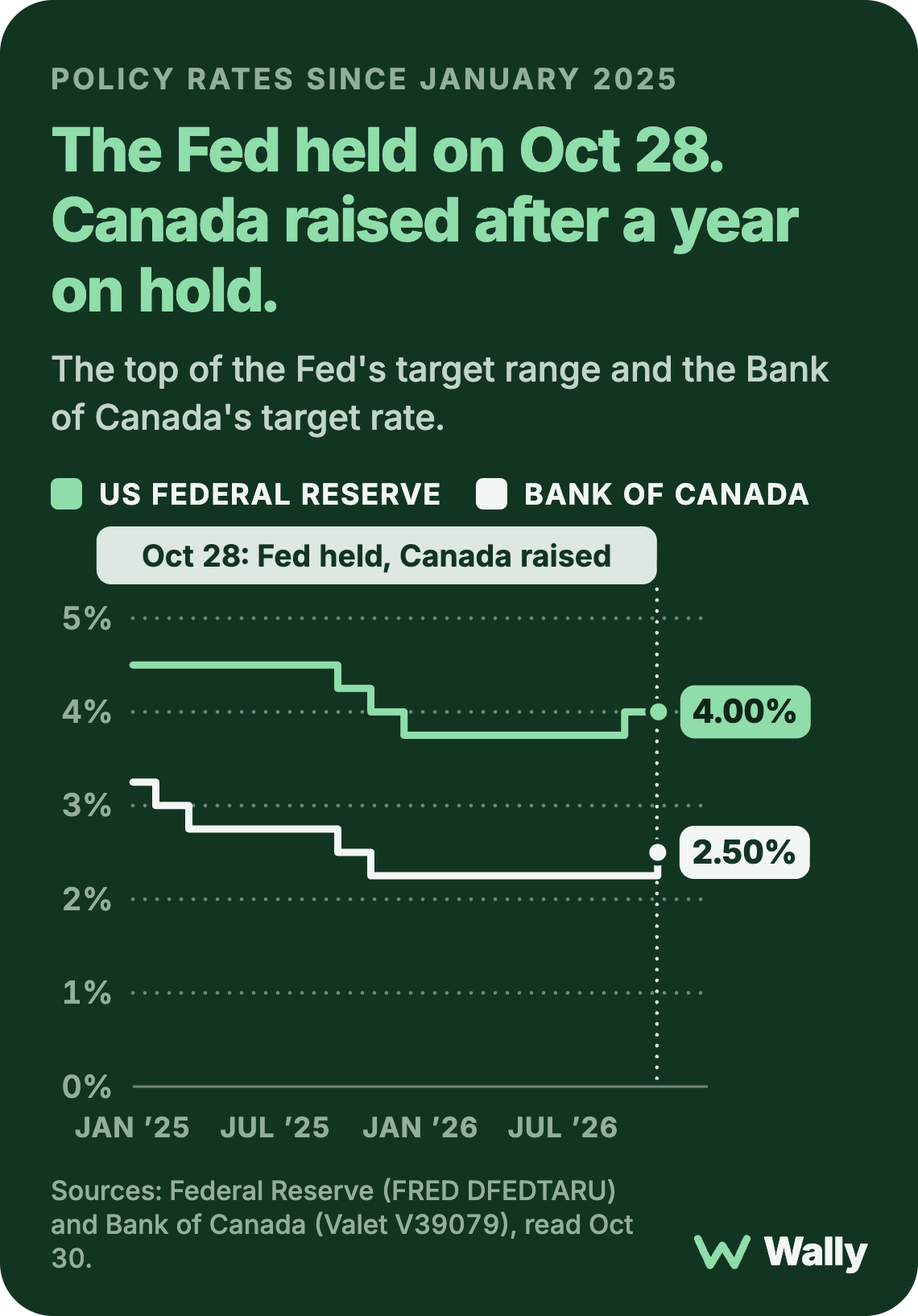
Chart source: Federal Reserve (FRED DFEDTARU) and Bank of Canada (Valet V39079), read Oct 30.
Wally can do this
How a Treasury bill pays you
A Treasury bill is sold for less than its face value and pays the full face value when it matures, in 4 to 52 weeks. The difference is your interest. You can buy bills at TreasuryDirect or through a brokerage, and the interest isn't taxed by states or cities.
Put it in your calendar
Coming up
- Jobs report · 8:30am ET
- Inflation report · 8:30am ET
Sources
- Federal Reserve
- BLS: September CPI
- Federal Reserve: prime rate (H.15)
- Federal Reserve: card rates (G.19)
- FDIC: national rates
- US Treasury: daily yields
- Freddie Mac: mortgage rates
- EIA: gasoline and diesel prices
Every figure checked against Federal Reserve, BLS, FDIC, US Treasury, Freddie Mac and EIA on Oct 31, by Meet, Wally's founder.
General information, not financial advice. Figures can change after the day they were checked; the linked sources are the final word.
Get the Monday Brief every week
It comes with Wally, the AI agent that finds what’s costing you money. Seeing what it finds is free. See past issues.