Monday Brief No. 3, Canada edition
The jobs report is in. What it means for your rates and your cushion
Figures checked Read the US edition
In this issue
3 min read
The October jobs report, and what it means for Dec 9
Plus!
- The federal budget came out Thursday, Nov 5.
- Prime is 4.70% after the Bank of Canada's hike.
This week
Must-read this week
The federal budget came out Thursday, Nov 5.
Finance Minister François-Philippe Champagne tabled Budget 2026 on Nov 5. It proposes a one-time 50% top-up to the Canada Groceries and Essentials Benefit, paid in early 2027: up to $339 for a single person and $679 for a couple with two children. It also proposes a refundable caregiver credit of up to $1,260 a year from 2027, and a national heat pump rebate.
What it means for you: These are proposals until Parliament passes them. If you get the groceries benefit now, the larger payment would come in early 2027. If you care for someone at home, watch for the new credit's rules.
Source: Department of Finance Canada
Prime is 4.70% after the Bank of Canada's hike.
The big banks' prime rate rose from 4.45% to 4.70% after the Bank raised its rate to 2.50% on Oct 28. Lines of credit, HELOCs and variable mortgages are priced off prime.
What it means for you: If you owe money at prime plus a margin, your next statement shows the higher cost. Check the rate on each line in your bank's app.
Source: Bank of Canada
Benefit payments this month: Nov 10 and Nov 20.
The Ontario Trillium Benefit is paid Nov 10 and the Canada Child Benefit Nov 20. The Alberta Child and Family Benefit follows on Nov 27.
What it means for you: If a payment doesn't arrive, the CRA asks you to wait five to ten working days before calling. Payments depend on a filed 2025 return, so file if you haven't.
Source: Canada Revenue Agency
The numbers
This week’s rates
Unemployment, October
6.7%
September was 6.5%
Statistics CanadaInflation, September
3.1%
August was 3.0%
Statistics CanadaBank of Canada rate
2.50%
up from 2.25% on Oct 28
Bank of CanadaPrime rate
4.70%
4.45% before the hike
Bank of Canada
The Big Money Move
The October jobs report, and what it means for Dec 9

Employment fell by 68,000 in September, a second monthly drop, and unemployment rose to 6.5% (Statistics Canada). In October employment was little changed (down 4,700) and unemployment rose to 6.7%. The Bank of Canada, which raised its rate to 2.50% on Oct 28, decides next on Dec 9.
Hiring has turned down.
Employment fell by 42,000 in August and 68,000 in September, and was little changed in October (down 4,700). Unemployment rose to 6.7%, below April's peak of 6.9% but above the 6.4% of the summer. Wages rose 2.2% in a year, less than prices (Statistics Canada).
What it means for you: Raises are running behind inflation and jobs are harder to find. It's the time to know what one month of your must-pay bills comes to, and to hold three to six of them in reach.
The Bank weighs jobs against prices.
The Bank raised its rate to 2.50% on Oct 28 because inflation is 3.1% and it expects about 3.5% by the end of the year. Weak hiring argues for a pause on Dec 9; prices argue for another hike.
What it means for you: Prime is 4.70%, and lines of credit and variable mortgages follow it. Paying down variable-rate debt before Dec 9 lowers what another hike would cost you.
Your cushion should earn while it waits.
The big banks' posted savings rate is 0.01%, and their posted 1-year GIC pays 2.45% (Bank of Canada).
What it means for you: An emergency fund belongs in a high-interest savings account you can reach in days, not a basic account at 0.01%. A GIC locks the money for its term, so keep it for savings you won't need soon.
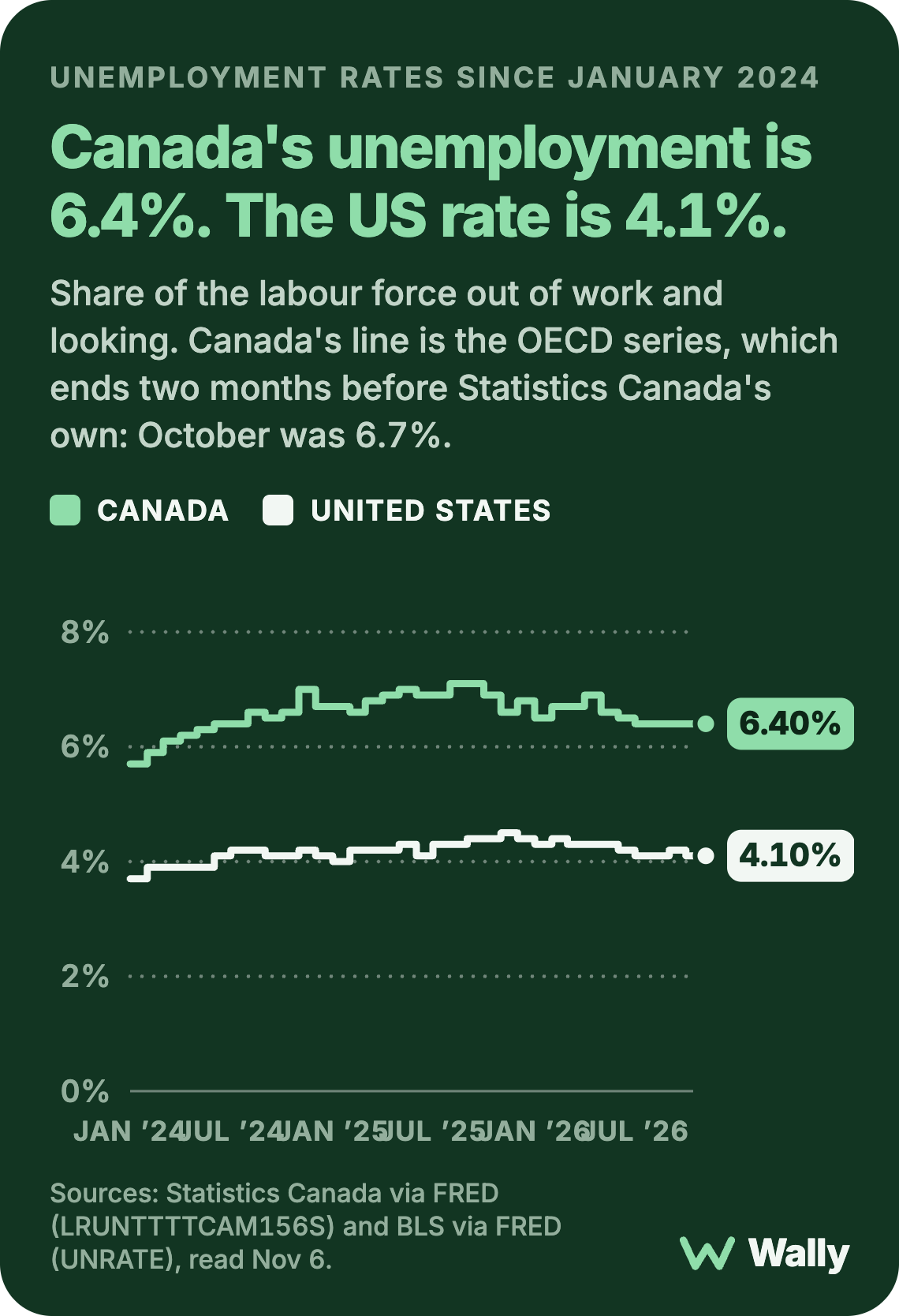
Chart source: Statistics Canada via FRED (LRUNTTTTCAM156S) and BLS via FRED (UNRATE), read Nov 6.
Wally can do this
How big an emergency fund
Add up one month of the bills you can't skip: rent or mortgage, utilities, groceries, insurance, minimum payments. Three to six months of that is the usual target. Keep it apart from your spending account, in a high-interest savings account you can reach in a day or two. A TFSA can hold it without tax on the interest.
Put it in your calendar
Coming up
- Ontario Trillium Benefit payment
- Bank of Canada: why it raised, in its own words
- Inflation report · 8:30am ET
- Canada Child Benefit
Sources
- Bank of Canada: rate announcement
- Bank of Canada: policy rate
- Statistics Canada: CPI
- Bank of Canada: posted rates
- Bank of Canada: posted rates and rate announcement
- Statistics Canada: September Labour Force Survey
- Statistics Canada: October Labour Force Survey
- BLS: October jobs report
- RBC Royal Bank: prime rate
- Department of Finance Canada: Budget 2026 key measures
Every figure checked against Bank of Canada, Statistics Canada, BLS, RBC Royal Bank and Department of Finance Canada on Nov 7, by Meet, Wally's founder.
General information, not financial advice. Figures can change after the day they were checked; the linked sources are the final word.
Get the Monday Brief every week
It comes with Wally, the AI agent that finds what’s costing you money. Seeing what it finds is free. See past issues.