Monday Brief No. 1, US edition
Two rate decisions on Wednesday: what each could cost you
Figures checked Read the Canada edition
In this issue
2 min read
The Fed decides Wednesday whether to raise rates again
Plus!
- Social Security checks rise 3.6% in January.
- Medicare open enrollment runs until Dec 7.
This week
Must-read this week
Social Security checks rise 3.6% in January.
Social Security set its 2027 cost-of-living raise on Oct 14. The average retirement check rises about $75 a month, and SSI payments go up from Dec 31.
What it means for you: Your exact new amount comes in your COLA notice. Sign up for paperless notices by Nov 18 to see it online in late November.
Source: Social Security Administration
Medicare open enrollment runs until Dec 7.
From Oct 15 to Dec 7 you can switch Medicare Advantage or drug plans, or move between Original Medicare and Medicare Advantage. Changes start Jan 1.
What it means for you: Plans change their costs and the drugs they cover every year. If you or a parent is on Medicare, compare next year's plan before Dec 7. Doing nothing keeps the plan you have.
Source: Medicare.gov
Marketplace health plans for 2027 open Nov 1.
Open enrollment on HealthCare.gov runs Nov 1 to Jan 15. Pick a plan by Dec 15 for coverage that starts Jan 1.
What it means for you: If you buy your own health insurance, plans and prices change for 2027. Compare yours before Dec 15.
Source: HealthCare.gov
The numbers
This week’s rates
Inflation, September
3.7%
up from 3.4% in August
BLSPrime rate
7.00%
most card rates follow it
Federal ReserveSavings, national average
0.38%
3-month Treasury bills: 4.22%
FDIC30-year mortgage
7.32%
6.19% a year ago
Freddie Mac
The Big Money Move
The Fed decides Wednesday whether to raise rates again
The Fed raised its rate a quarter point on Sep 16, to 3.75% to 4.00%. Prices kept speeding up: inflation reached 3.7% in September, from 3.4% in August (BLS). The Fed decides again at 2pm ET on Oct 28, hours after the Bank of Canada.
Your card rate moves with prime.
Most credit cards charge the prime rate plus a margin. Prime is 7.00% and follows the Fed's rate, usually from the next day. The average card charges 22.4% a year (Federal Reserve).
What it means for you: A hike on Wednesday shows up on card statements within a cycle or two. Every dollar you pay down stops costing you your card's rate.
Savings pay far less than the Fed's rate.
The average savings account pays 0.38% (FDIC). Three-month Treasury bills pay 4.22%.
What it means for you: If your savings earn the average, they earn far less than the Fed's rate, hike or not. A high-yield account or T-bills pay closer to it.
Mortgage rates follow bonds, not the Fed.
The average 30-year fixed rate is 7.32%, up from 6.19% a year ago (Freddie Mac).
What it means for you: If you're buying a home, watch the 10-year Treasury yield more than Wednesday's decision.
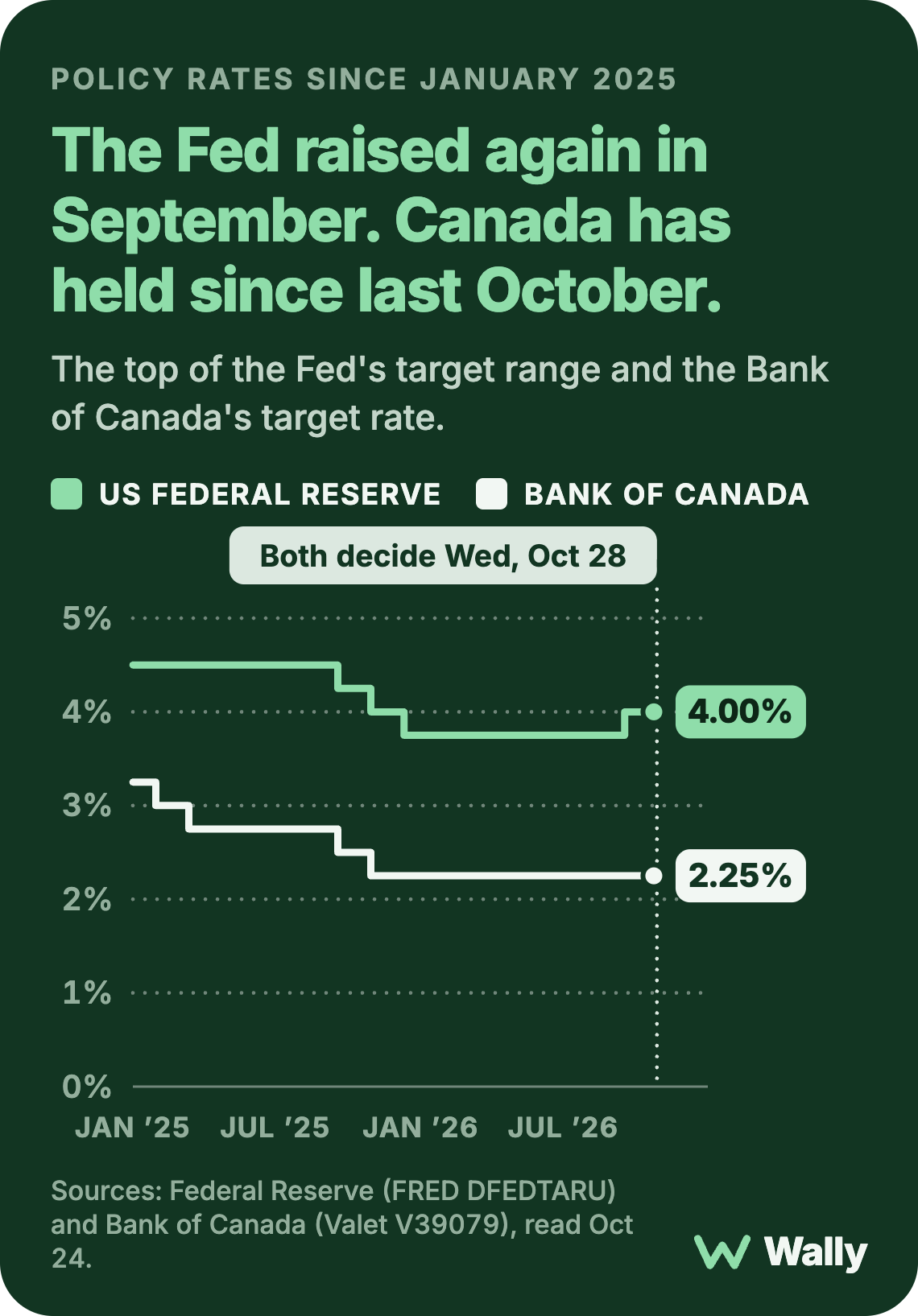
Chart source: Federal Reserve (FRED DFEDTARU) and Bank of Canada (Valet V39079), read Oct 24.
Wally can do this
How card interest is worked out
Most cards divide the yearly rate by 365 and charge that much every day on the balance you carry. So interest grows each day a balance sits there. Paying part of it before the statement date lowers the balance it's charged on, and the interest with it.
Put it in your calendar
Coming up
- Fed rate decision · 2pm ET
- Health insurance marketplace opens
- Jobs report · 8:30am ET
Sources
- Federal Reserve
- BLS: September CPI
- Federal Reserve: prime rate (H.15)
- Federal Reserve: card rates (G.19)
- FDIC: national rates
- US Treasury: daily yields
- Freddie Mac: mortgage rates
- Social Security Administration
Every figure checked against Federal Reserve, BLS, FDIC, US Treasury, Freddie Mac and Social Security Administration on Oct 24, by Meet, Wally's founder.
General information, not financial advice. Figures can change after the day they were checked; the linked sources are the final word.
Get the Monday Brief every week
It comes with Wally, the AI agent that finds what’s costing you money. Seeing what it finds is free. See past issues.